
Sonny Hayes Would Never Pass the Medical
, 7 min read
A Formula 1 fan's review of F1 the movie, whose hero would fail an FIA medical on day one and whose young Black driver deserved far better.
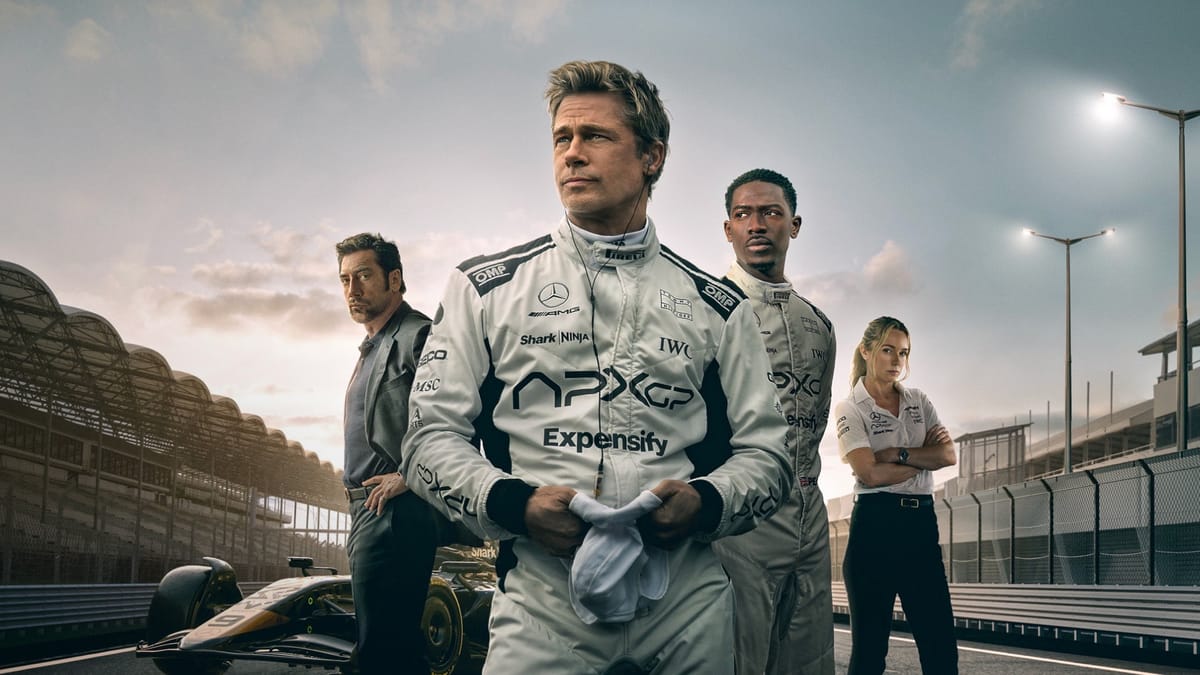
The cinema cheered in all the places it was meant to. The music told everyone when, the editing told everyone who the hero was, and the crowd did its part. I left angry, which is not how I usually leave a film about a sport I have followed most of my life.
Preethi had written it off before we bought the tickets. It would be Hollywood's retelling of Formula 1, she said, and it would outdo Drive to Survive for manufactured drama. She was right, and most of the world disagreed with both of us. F1 made $634 million, more than any other Brad Pitt film, and won the Oscar for Best Sound, which it deserved. The racing was filmed on real circuits during real Grand Prix weekends, and Pitt knows exactly how to fill a screen. It looks and sounds like Formula 1. It just doesn't think like it.
He fails the medical on day one
Sonny Hayes comes back to Formula 1 thirty years after a crash at the 1993 Spanish Grand Prix ended his first career. His old teammate Rubén Cervantes now owns APXGP, a team at the back of the grid that has to win one of the last nine races of the season or be sold, and Sonny is his answer. My problem with the film starts there, long before anyone wins anything, because Sonny should never have been allowed in the car.
Late in the film the team finds out what he has been hiding. He broke his back in 1993, he has screws in his spine, and he races the finale concealing blurred vision and headaches. No driver with that history gets through an FIA medical, and a man thirty years out of the sport would never have been given a super licence in the first place. In Abu Dhabi he turns up after qualifying is over and still starts the race, though the regulations only allow a change of driver before qualifying begins, and a car that sets no time needs the stewards to make an exception just to start from the back.
Formula 1 cars run inches apart at 300 km/h, and every driver on the grid is trusting everyone else to see where they're going. Putting a man with a damaged spine and failing eyesight among them, one who also crashes into people on purpose, would be murder in sport form.
Plan C is for chaos
Sonny's way of saving the team is what they call Plan C, for chaos. He crashes on purpose to bring out safety cars, backs the pack up into a DRS train to open a pit window for JP, and holds up Max Verstappen on fresh tyres with his old ones, which anyone who has watched Max take a gap that doesn't exist will find hard to believe. At one race he sits in his pit box like a petulant child and refuses to leave until the crew fits the softs he wanted. The film frames every one of these as proof that he sees what nobody else can.
Formula 1 has seen the safety car trick before. At the 2008 Singapore Grand Prix, Nelson Piquet Jr crashed on team orders to bring out a safety car for Fernando Alonso, who went on to win. When it came out a year later, Flavio Briatore and Pat Symonds were banned from the sport, though a French court later overturned the bans. The film turns one of the lowest moments in modern F1 into a running gag.
Deliberate crashes are how people get hurt. Rush never let anyone forget that drivers could die, and it still found room for Niki Lauda telling us God gave him an okay brain and a great arse. F1 gives us a hero who orders safety cars on demand, and a team that ends a briefing chanting "combat, combat, combat", which in the real paddock would bring the FIA down on them faster than anyone could say Plan C.
The engineer already knew
Kate McKenna is the technical director, and the film makes a point of telling us she's the first woman in F1 to hold the job. Her car is a mess until Sonny pitches her, over a beer, on building it for combat. The upgrade she delivers is a revised floor that lets the car follow through dirty air without losing as much performance, which every technical director on the grid already has at the top of the list. It doesn't need a driver who knows nothing about modern aerodynamics to suggest it, and one floor update doesn't turn a backmarker into a race winner. Somewhere along the way she spends the night with him after a poker game. The first woman to run an F1 technical department ends up as the love interest, building a car the hero thought of in a bar.
Thirty years is a long time in F1
To be fair, Sonny hasn't spent those thirty years on a sofa. He opens the film by winning the 24 Hours of Daytona. But the last Formula 1 car he drove raced against Senna's, and on his first run he's within a second of JP, in a car whose steering wheel is a small computer. He wouldn't even get all the buttons right. Lewis Hamilton, seven titles and all, went through his first season at Ferrari in 2025 without a single Grand Prix podium, the first time that had happened to him since he joined F1 in 2007, while Charles Leclerc took seven podiums in the same car. Learning how one particular car wants to be driven took Hamilton a full season and more.
Nobody pays for any of it either. APXGP destroys cars at a rate that would sink a team with money, and F1 has had a cost cap since 2021. A backmarker writing off chassis this often would run out of budget long before it ran out of races.
What a backmarker win looks like
A small team winning is possible, which is what makes the shortcuts so frustrating. Sergio Pérez fell to last on the opening lap of the 2020 Sakhir Grand Prix and won it. Alpine took a double podium in Brazil in 2024. Midfield teams celebrate a sixth or a tenth like a win, because against Red Bull, Ferrari, McLaren and Mercedes, that is the win. The film could have set that expectation, a slower car beating a few faster ones, or told the story over several seasons the way Goal! did with football. Fans forgive a lot when a win comes from out-thinking the other teams, braking later and pitting faster, and very little when it comes from hitting people.
A mentor who makes a copy
Joshua Pearce is a rookie with real talent and a real ego, which is a good setup for a sports film. What he needs is someone to develop him, and what he gets is Sonny. Over the second half of the season JP starts racing the way Sonny races and motivating the team the way Sonny did, and the film treats that as growing up. The rules only run one way. When Sonny wipes out JP, it's character building, a team that doesn't let anyone get ahead of it. When JP takes Sonny out, he has thrown away every chance he had.
It's hard to watch without seeing a white saviour story. JP is a young Black man in a sport that has had one Black driver in its history, and the film shows none of the grit, focus or dedication it would have taken him to get there. It shows him behaving like an entitled rich kid, partying before race days, with his cousin and manager pushing him onto social media and insisting the party keep going after 1 am. The manager is the comic relief, a hype man chasing the money, and the film named him Cashman. After a bad race, the photographers catch JP showing off his jewellery. He only earns the team's respect once he starts doing what the older white driver does.
Lewis Hamilton's name is on this
That one Black driver is one of the film's producers, and this is the part that hurt. Hamilton knows better than anyone what it took to be the only Black man on the grid. He had to be the cleanest and most charismatic driver in the paddock, because if he had spoken as bluntly as Max does, the press would have gone for his throat. He built his respect on his own and never bowed to anyone to get it. JP, in a film with Hamilton's name on it, is handed every stereotype Hamilton spent his career refusing to give anyone, and is respected only once he becomes a copy of the white veteran. I'm a Hamilton fan, and that is where the anger I walked out with came from.
A baton with nothing behind it
In Abu Dhabi, after a red flag sets up a three-lap sprint, Sonny holds off Hamilton so JP can take the lead. On the final lap JP and Hamilton collide, the only two Black drivers in the race taking each other out, and Sonny wins. Hamilton is as clinical and precise wheel to wheel as anyone who has raced, a man who has handled Max more often than not when he has had the car to do it, and the film has him crash into a rookie.
Sonny winning bothers me far less than Sonny racing at all, and Pixar has already shown how this kind of ending should work. By Cars 3, Lightning McQueen is a seven-time champion with two films behind him. In the final race he pulls into the pits, has his crew put his number on Cruz Ramirez and talks her through the field, and she wins it, with the victory credited to both of them. The handover works because we spent two films learning what Lightning was handing over. F1 sets up the same veteran-and-rookie story with a hero it met two hours earlier, and then doesn't pass the baton at all.
The last we see of Sonny, he's racing across the desert in Baja, screws and all, off to whoever will have him next. JP stays behind with the team, the car and, by his own count, a million races to win.